
The Challenge of Complex AV Networks
Designing modern audio-visual networks is a demanding task, even for seasoned system engineers. A typical large-scale AV setup might involve dozens of devices linked via fiber-optic rings, combining various protocols and topologies to meet complex requirements. Ensuring reliable connectivity and full redundancy in these environments requires careful planning and expert execution. Every time a device is added, moved, or removed, the network often needs reconfiguration of fiber patch cables to maintain a closed loop. This manual repatching is time-consuming and can lead to mistakes – especially in live events or large installations where changes are frequent and time is critical.
AutoRouter: The Intelligent Fiber Patchbay Solution
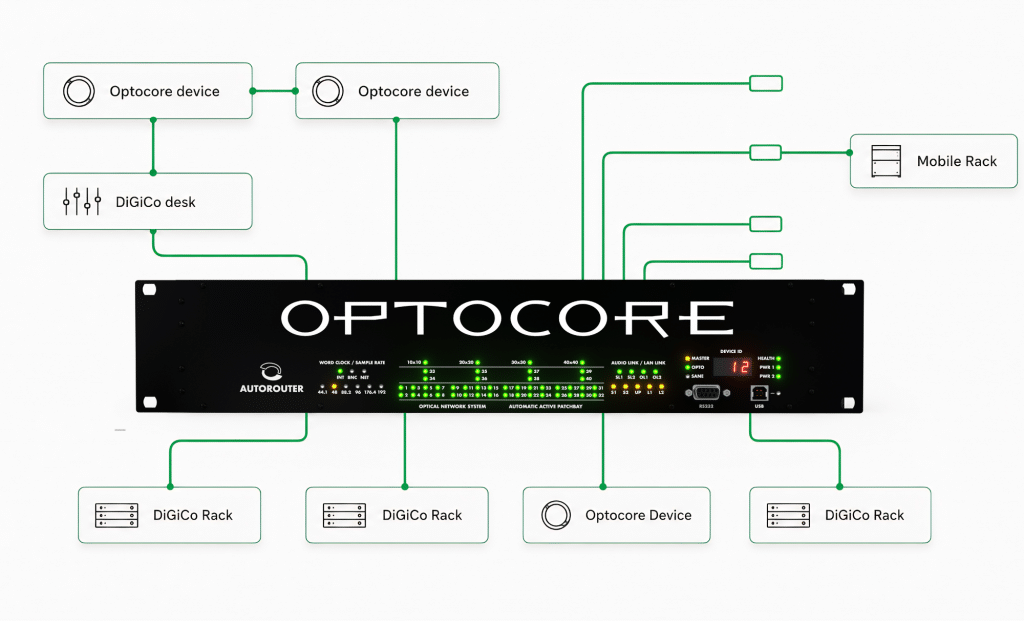
Optocore’s answer to these challenges is the AutoRouter – an intelligent fiber patchbay designed to simplify complex AV networks. It effectively creates a redundant “star” topology out of the traditional fiber ring, preserving the ring’s fault-tolerant redundancy while providing the flexibility of a star layout. The device is entirely plug-and-play: it automatically discovers any connected devices and links them into a unified, redundant fiber network with no manual configuration required. As devices are added or removed at various points, the AutoRouter dynamically re-routes signal paths to keep the system fully redundant. Technicians no longer need to manually repatch optical cables when the system changes, since the network automatically adjusts itself. Importantly, AutoRouter is not limited to native Optocore standalone systems – it also integrates seamlessly with DiGiCo fiber loops and Clear-Com’s ProGrid installations. Furthermore, it supports other ring-based audio network protocols such as Avid’s AVB and Yamaha’s TWINLANe, making it a broadly compatible solution for many different professional setups.
Each AutoRouter unit supports up to 20 fiber connections (dual-link ports), and each connection point can represent an entire location – for example, a stage box position, a wall panel, or another patch point in the venue. Multiple devices, or even a sub-loop of devices can be connected at each of these locations, all managed through the single AutoRouter. This means a single AutoRouter can intelligently handle a large number of devices spread across different areas, automatically forming one resilient network. If one of these connection points goes unused – for example, if a device at that location is powered down – the AutoRouter immediately closes the loop among the remaining active connections so that the network’s redundancy remains intact. The system continually self-adjusts to maintain a solid network path and ensure the optical ring remains closed.
Key Features and Benefits
- Plug-and-Play Setup: AutoRouter is truly plug-and-play – it requires no user configuration or manual switching. Connect your Optocore-enabled devices (or supported third-party devices) and the AutoRouter auto-routes everything. The network “always discovers and switches the links automatically to establish redundancy, without any user action”, dramatically speeding up system layout and reconfiguration.
- Automatic Redundancy (Loop Closure): The AutoRouter constantly monitors the network and automatically closes the loop between active devices. If a device is turned off or a cable is unplugged, the system immediately re-patches internally to maintain a closed loop with the remaining nodes. There is “no longer the need to patch cables manually, as the system is always redundant.” This fail-safe operation means zero audio downtime during device swaps or unexpected disconnects – a critical advantage in live sound environments.
- Scalable for Large Networks: Each AutoRouter can host up to 20 device connections (it provides 40 fiber LC ports for 20 duplex links). That scalability makes it suitable for very large systems – from multi-level theatre complexes to 100,000-seat stadiums. Need more nodes? Multiple AutoRouters can be deployed to link different zones or floors while still behaving as one cohesive network. The design also includes dual power supplies for redundancy and has no cooling fans, ensuring silent and reliable 24/7 operation (ideal for noise-sensitive venues).
- Interoperability and Protocol Agnosticism: Uniquely, Optocore’s AutoRouter plays well with non-Optocoresystems. It’s compatible with stand-alone Optocore networks, DiGiCo fiber loops, and Clear-Com’s ProGrid, among others. The same auto-routing functionality extends to third-party protocols that use ring topologies – for example, Avid’s AVB network and Yamaha’s TwinLANe cards are fully supported. This means an AutoRouter can intelligently patch together mixed fiber networks across different console brands and protocols. In a nutshell, it’s a protocol-agnostic solution that preserves your existing investments and ties them into one transparent, redundant system.
Real-World Applications
It’s not just theory – AutoRouter is already simplifying complex AV systems in the real world. Large venues and “campus-style” facilities have embraced this technology to eliminate patching headaches. For instance, Optocore’s AutoRouter was deployed in a vast Stadium during its FIFA World Cup redevelopment, as well as in the sprawling Westfield London mall, to connect numerous audio nodes with ease. These high-profile installations proved that even in an 80,000-seat stadium or a multi-zone public complex, an intelligent fiber patchbay can drastically streamline audio distribution.
In sophisticated concert halls like the Helsinki Music Centre, AutoRouter adds crucial flexibility. When this 1,700-seat Finnish venue upgraded its sound system, they used AutoRouter to link the main hall with five satellite performance spaces. This allowed the crew to free their DiGiCo FOH console from a fixed position and redeploy it as a mobile unit – any console or rack can now be connected from any location and instantly recognized by the network. “AutoRouter has been essential for the update,” confirms Jori Tossavainen, the venue’s sound manager. He noted that it is “perfectly suited for installations with multiple connection points and mobile stage boxes, as well as for live events”. In other words, what used to be a complex re-patching exercise (moving a console or adding a stagebox for a special event) is now basically plug-and-play.
Even in large conference centers and houses of worship, the AutoRouter has proven invaluable. A mega-church in the U.S., for example, recently unified its sanctuary and fellowship hall fiber networks using an Optocore AutoRouter – replacing a manual patch bay setup. The integrator, Paragon 360, reports that switching audio feeds between rooms went from a tedious, error-prone process to a seamless one, with the broadcast console gaining full access to all inputs at any time. It’s a testament to how intelligent patching saves time and prevents mistakes. Front-of-house engineers and system designers praise AutoRouter for exactly this reason: it simplifies their workflow. As one veteran consultant put it, the AutoRouter makes remote stage racks appear on the network “as soon as you connect the cable”, that is drastically reducing setup time and stress during big productions.
A New Standard for Complex AV Networks
From stadium tours to permanent installations, the Optocore AutoRouter is redefining how we design large audio networks. By functioning as an automatic patchbay with built-in smarts, it eliminates the usual trade-off between flexibility and redundancy. Engineers no longer have to choose between a convenient star layout or a safe ring topology – they get both at once. The result is fewer manual patch points (and thus fewer human errors), faster setup and changeovers, and peace of mind that the network is always self-healing and fault-tolerant.
In today’s AV world, where events are bigger and systems more interconnected than ever, such intelligent patching is a game-changer. AutoRouter’s success on a major world tour (it made its debut on a Coldplay tour) and its adoption in venues worldwide underscore its reliability and impact. It empowers system integrators and FOH crews to focus on the show itself rather than on chasing cables. In short, AutoRouter simplifies complex AV networks making high-channel-count, multi-location audio systems not only possible, but easy to manage and bulletproof in operation.